 THE FIRE LAB · OFFENSIVE DEFENCE
The front door was the only way out. The e‑bike was charging in front of it.
An electric bicycle battery failed in a Bronx apartment before one o’clock on Wednesday morning, in the kitchen, between the family and the only door. The chemistry made the fire fast. Where the bike was parked made it fatal — and that is the part every site owner controls.
Shortly before 1 a.m. on Wednesday 28 October, the New York Fire Department was called to the eleventh floor of 320 Morris Avenue, a thirteen-storey block in the Patterson Houses in Mott Haven, the South Bronx. The first units were on the street in three minutes and thirty-eight seconds. Thirty-eight units and 120 fire and EMS personnel attended, and the fire was under control a little after two. Firefighters carried five people out of a single apartment.
By Friday four of them were dead: an eleven-year-old boy, two teenagers aged fifteen and sixteen, and a thirty-three-year-old woman. A thirty-seven-year-old man survived. One victim was found directly behind the apartment door.
The ignition source, FDNY investigators said within hours, was the lithium-ion battery of an electric bicycle kept inside the flat. But the determining factor was not the chemistry. It was the geometry.
“An e-bike was placed in the pathway of the exit door,” Commissioner Lillian Bonsignore told reporters that morning. Chief of Department John Esposito put it more plainly: the fire and the bike “were in the path of egress, so the people in the apartment were not able to get out.” A neighbour said the family had been given the bike by another resident of the same building two or three weeks earlier, and had been warned more than once not to charge it indoors near the stove.
WHY THIS CLASS OF FIRE BEHAVES DIFFERENTLY
A lithium-ion cell in thermal runaway is not burning in the ordinary sense. Above a threshold temperature the cell’s own internal chemistry becomes exothermic: it generates heat faster than the pack can shed it, and the cathode material decomposes and liberates oxygen as it goes. The reaction therefore carries part of its own oxidiser and does not need the room’s air to continue. That single fact invalidates most of what a building’s fire strategy assumes.
Smothering fails, because there is nothing to smother. A carbon-dioxide or dry-powder extinguisher knocks down the flame front for a few seconds, leaves the heat source untouched, and the fire returns. Sealing the device in a container is worse: the vented gas has nowhere to go and the pressure finds its own way out. What the pack vents is a flammable, toxic mixture — hydrogen, carbon monoxide, electrolyte vapour and hydrogen fluoride among it — released fast enough that in a confined room it can reach its ignition limits before the plastics around it have properly caught. That is the deflagration occupants describe as an explosion, and it is why these fires take the escape route before they take the building.
Propagation does the rest. One failed cell heats its neighbour, which fails in turn; large packs are engineered to interrupt that chain and second-hand packs of unknown history frequently cannot. The hazard then persists, because undamaged cells inside a scorched pack can re-ignite hours or days later.
The only thing that addresses the actual problem is heat removal, in volume and sustained. That is a water-supply question, not an extinguisher question — and a question about where the battery sits relative to the hose, the lobby and the stairs.
THE NUMBER BEHIND THE INCIDENT
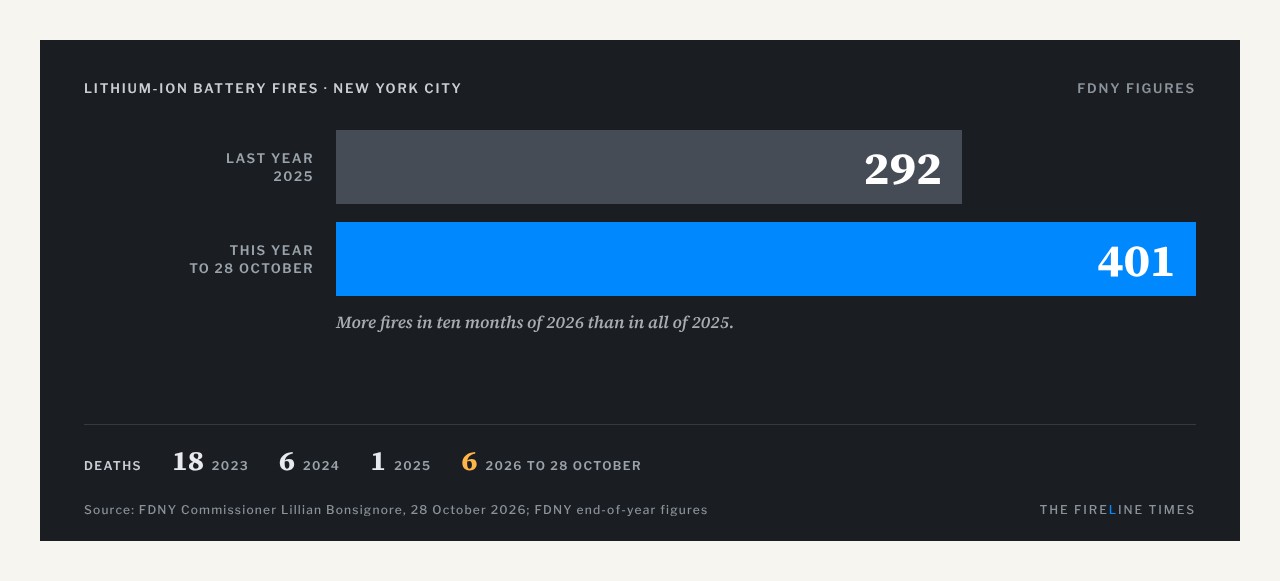
New York is the best-instrumented city in the world for this failure mode, and its data is not improving. Bonsignore reported 401 lithium-ion battery fires in the city so far in 2026, with 74 injuries and six deaths, against 292 fires, 51 injuries and one death last year. Those figures were given on 28 October, before three of the four Bronx victims died. Fatalities had fallen from eighteen in 2023 to six in 2024 and one in 2025; 2026 has undone that progress in ten months. FDNY officials attribute part of the rise to the number of ageing packs now in circulation, and advise charging and storing devices outside the dwelling wherever possible.
Asked about purpose-built e-bike storage in public housing, including rooms built out in cinderblock, Mayor Zohran Mamdani said every suggestion would be considered. Masonry is the right instinct and an incomplete answer. A battery room without detection, without ventilation routed away from occupied space, and without a means of getting water onto a pack is a container for a fire, not a control for one — and if it sits on the route residents use to leave, it reproduces the Bronx failure at building scale.
QUESTIONS WORTH ASKING THIS WEEK
- Where on your site are lithium-ion devices actually charged overnight — not where policy says, where they are?
- Does any charging point sit in a corridor, lobby, stairwell, kitchen or doorway forming part of a means of escape?
- If a pack vents in that location, where does the gas go, and who walks through it?
- What is the water supply within reach of that point, and who is trained to apply it for long enough to matter?
- How many batteries on your site are second-hand, out of warranty, or of unknown provenance — and who is allowed to bring one in?
- After a battery incident, who owns the decision to keep monitoring the pack for the next twenty-four hours?
None of these questions requires a purchase to answer. Four of them would have changed the outcome at 320 Morris Avenue.
ELSEWHERE LAST WEEK
Newport, Oregon, 25 October. Fire at Pacific Seafood’s Bayfront plant on Yaquina Bay prompted a one-mile evacuation over fears ammonia tanks would rupture; crews held the flames off the tanks and the zone was cut to a few blocks. One firefighter was hospitalised for exhaustion.
Cedar Rapids, Iowa, 24 October. An explosion and fire broke out in a product-handling area at PepsiCo’s Quaker Oats milling plant. All workers were accounted for; the cause is under investigation.
Mangolpuri, Delhi, 30 October. Fire began in the basement of a shoe manufacturing unit in Industrial Area Phase-I and trapped workers on the upper floors of a four-storey building. Four people died and two were injured. Two men have been arrested.
Hillsville, Virginia, 29 October. Two people died in a fire in Carroll County. State police say it does not appear suspicious; the state Bureau of Criminal Investigation is looking into it because of the deaths.
SOURCES
NYC Mayor’s Office, Transcript: Mayor Mamdani holds press conference on Bronx fire with FDNY Commissioner Lillian Bonsignore, 28 October 2026 · FDNY, 2025 end-of-year figures · Gothamist, 28 Oct 2026 · amNY, 28 Oct 2026 · NY1, 30 Oct 2026 · NBC New York, 28 Oct 2026 · OPB and AP, 25 Oct 2026 (Newport) · AP, 24 Oct 2026 (Cedar Rapids) · The Print and The Hans India, 31 Oct 2026 (Mangolpuri) · WDBJ7, 30 Oct 2026 (Carroll County) · International Fire & Safety Journal, 13 Aug 2026, on thermal-runaway behaviour.