 THE FIRE LAB · OFFENSIVE DEFENCE
Fifty feet in the guide. A few feet on the forecourt.
One burning electric SUV spread fire to seven more at a Texas car dealership this month, and kept firefighters there for 17 hours. The carmaker’s own guide says a burned EV should be kept about fifty feet from other cars. On a forecourt they sit a few feet apart.
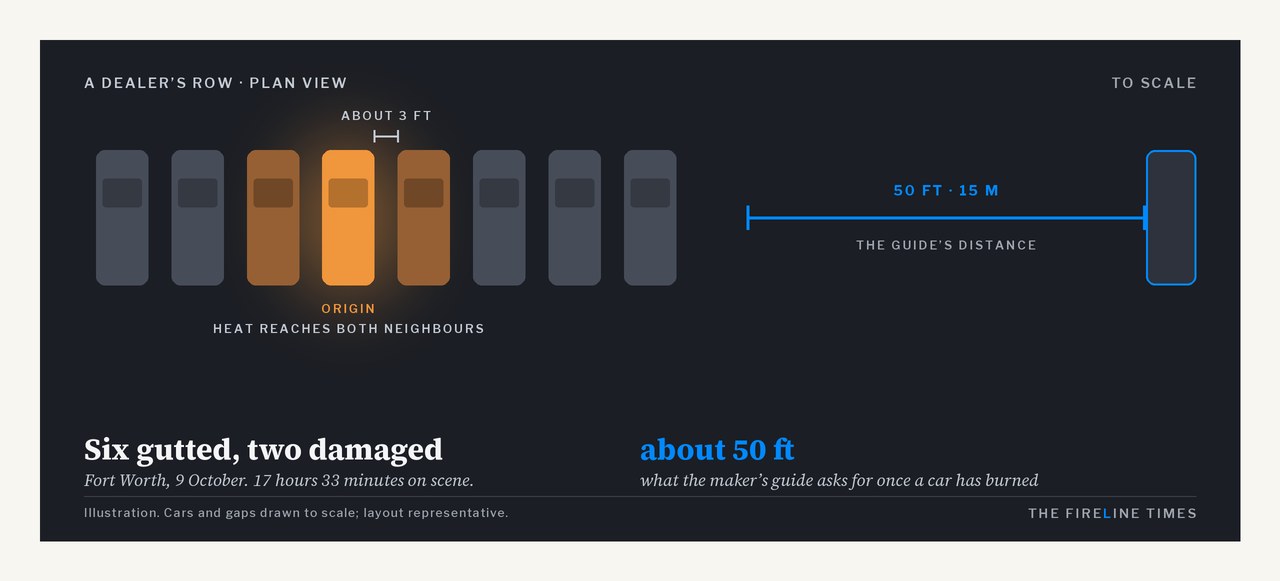
At about 5pm on Friday 9 October, Fort Worth Fire Department sent Engine 23 to a vehicle fire at Frank Kent Cadillac, a dealership on the city’s west side. Crews found one SUV fully alight and the fire already moving to the cars parked beside it. All of them were electric.
Six vehicles were gutted and two more damaged. Nobody was hurt. The last crew went back in service at 10:30 the next morning, 17 hours and 33 minutes after the first call. The cause is still under investigation.
Crews laid fire blankets over the burning cars. Not to put them out, but to hold the fire back long enough for the cars next to them to be moved. Then they rotated through the night. The department’s spokesman, Craig Trojacek, put the difficulty simply: getting water “into an area that is manufactured to be completely sealed off.”
WHAT IS DIFFERENT
Electric cars do not catch fire more often than petrol ones. The UK government’s interim guidance on covered car parks says so plainly. The difference is what happens next. The same guidance puts the time to extinguish an electric car at 6 to 49 minutes, against 5 for a petrol car, and the water needed at around 10,000 litres against 4,000. In the fires it reviewed, 13% of electric vehicles reignited after they had been put out.
The carmakers’ own instructions point the same way. General Motors’ guide for firefighters and tow operators on the Escalade IQ says a burned vehicle should be kept about fifty feet from other cars. This month Volkswagen told the owners of nearly 73,000 electric cars not to charge above 80% while it finds a fix for faulty battery cells.
In my opinion those are the industry’s real controls for battery fire, and both are about distance and charge, not about putting the fire out.
WHERE CARS SIT IN ROWS
That matters most where cars are parked in rows. A dealer parks stock a few feet apart, at whatever charge it arrived with, and nobody is there overnight. A rental compound, a fleet yard or a covered car park is much the same, usually with less water to hand. The UK guidance notes that more space between cars cuts the heat reaching the next battery. In my estimation the Fort Worth crews spent their first hour making the space the layout had not given them.
Nothing released so far links this fire to a defect or a recall. I expect we will find it did not need one. One battery in trouble, and a neighbour parked close enough to catch the heat.
THREE QUESTIONS WORTH ASKING THIS WEEK
If a car in the middle of your row caught fire at 2am, who would know, and how quickly?
What charge are the vehicles on your site sitting at tonight, and who decides?
Could you move the undamaged ones without walking into the heat?
SOURCES
Fort Worth Fire Department, incident at Frank Kent Cadillac, 9–10 October 2026, as reported by Firehouse.com, Six Electric Vehicles Burn in Fort Worth, TX, Car Dealership Lot, 12 October 2026 · General Motors, Escalade IQ emergency response guide, as reported by The Auto Wire, 15 October 2026 · Ove Arup & Partners for the Office for Zero Emission Vehicles, Covered car parks — fire safety guidance for electric vehicles, interim guidance, July 2023 · Volkswagen recall 93EX (NHTSA 26V630), 72,668 vehicles, as reported by Electrek, 21 October 2026.