 THE FIRE LAB · OFFENSIVE DEFENCE
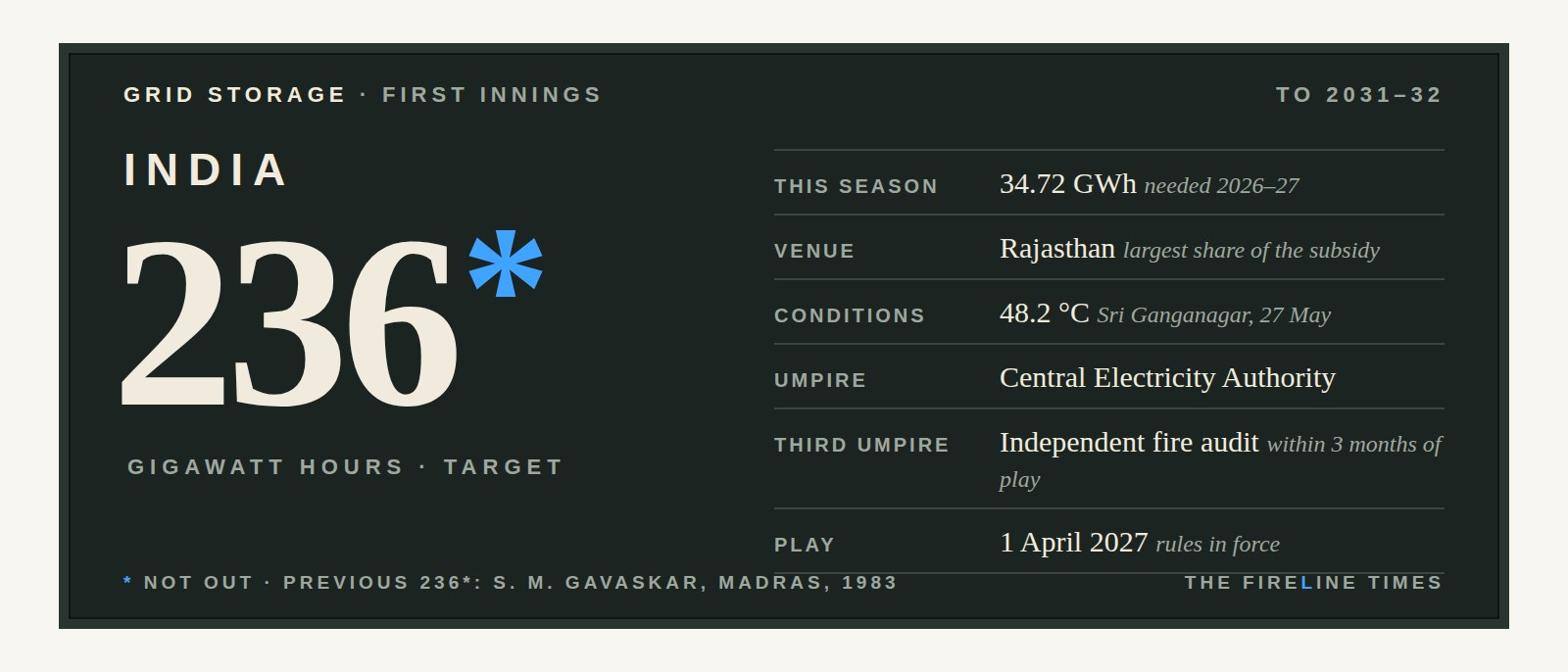
Two hundred and thirty six not out.
It is the target, not the score. India's national plan says the grid needs two hundred and thirty six gigawatt hours of batteries by 2032, and the largest share of the money to build them goes to Rajasthan, where the thermometer at Sri Ganganagar reached 48.2 degrees in May. From April 2027 every container must carry automatic fire suppression, and every installation must pass an independent fire audit within three months. The rules are written before the innings starts. That is the right way round, and it is rarer than it sounds.

Start with the number, because it is the kind of number that is easy to read and hard to picture.
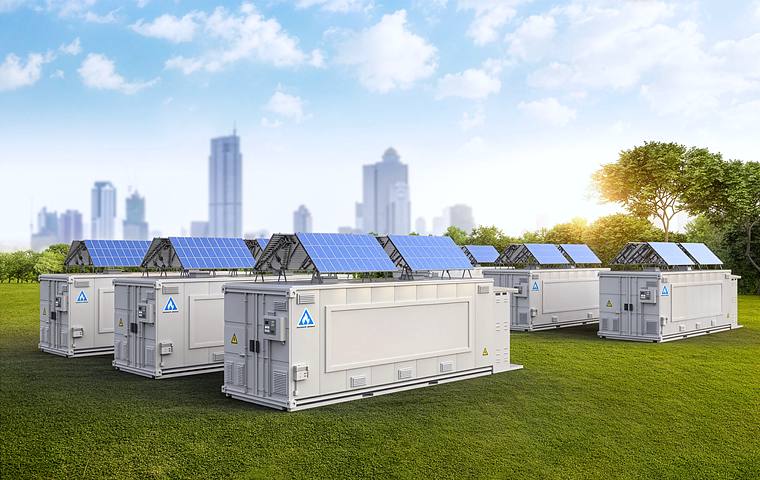
India's National Electricity Plan puts the country's need for battery storage at just under thirty five gigawatt hours in the coming financial year, and at two hundred and thirty six gigawatt hours by 2031–32. The second figure is roughly seven times the first, arrived at in five years. For scale, one gigawatt hour is in the order of a million of the cells in an electric car, sitting in steel containers in a field, charging from the sun in the afternoon and discharging into the grid after dark.
The government is paying to get it started. The Ministry of Power's viability gap funding scheme, fifty four hundred crore rupees against thirty gigawatt hours of standalone storage, is split across fifteen states, with the three largest allocations going to Rajasthan, Gujarat and Maharashtra and a block reserved for NTPC. Behind that sits a tender wave: the Solar Energy Corporation's ninth firm-and-dispatchable round with mandatory co-located storage, POWERGRID's first thousand megawatt hours for grid stability, Rajasthan's own two thousand megawatt hour round, and SJVN's in Haryana. Bids on most of them closed in July and August. The containers will start arriving next year.
WHERE THEY ARE GOING
Rajasthan has the most sun in India, the most spare land, and the largest single allocation of the storage subsidy. It also had, on 27 May, the highest temperature recorded in the country this year, 48.2 degrees at Sri Ganganagar.
A lithium cell does not like that. Its comfortable working range ends somewhere around forty five degrees, above which it ages faster, and its safety margin narrows as it warms. The containers are cooled, of course, and a good one is designed for the site. But cooling is a system, and a system can fail, and a system that fails on the one afternoon in May when the ambient air is already at forty eight is failing at exactly the wrong time. Every battery fleet in the world has to plan for the day the air-conditioning stops. India's has to plan for that day in a place where the outside air is already hotter than the cells are rated for.
That is not an argument against building in Rajasthan. The sun is in Rajasthan. It is an argument for building it properly, which is where the regulator comes in.
WHAT THE RULE SAYS
On 27 March the Central Electricity Authority notified an amendment to its safety regulations covering battery storage connected above six hundred and fifty volts, which is to say the grid fleet. It takes effect on 1 April 2027.
It asks for a good deal. Two-fault tolerance, meaning the installation must remain safe, or shut itself down safely, after two independent things have gone wrong. A battery management system that watches voltage, temperature and current at the level of the cell, the module and the rack, and stops charging or discharging when a limit is crossed. Explosion protection in the container, with forced ventilation and louvres that open on their own, and a rule that if the ventilation fails the system shuts down rather than let gas build up. Detection for smoke, gas, heat and flame. Automatic fire suppression in every battery container. Minimum spacing between containers and buildings, set by chemistry. A fence, cameras, sensors. And an independent third-party fire safety audit of every installation within three months of the rules taking effect, with the report going to the Electrical Inspector.
| 34.72 GWh | Battery storage the National Electricity Plan says India needs in 2026–27. |
|---|---|
| 236.22 GWh | The same figure for 2031–32. |
| ₹5,400 crore | Viability gap funding for 30 GWh of standalone storage across fifteen states and NTPC. Largest allocations: Rajasthan, Gujarat, Maharashtra. |
| 48.2 °C | Sri Ganganagar, Rajasthan, 27 May 2026. Highest reading in India this year. |
| 27 March 2026 | CEA safety amendment notified. Applies to storage connected above 650 V. |
| 1 April 2027 | Amendment in force. Automatic suppression in every container; two-fault tolerance; independent fire audit of every installation within three months of it. |
Read that list against what most of the world's grid batteries were built under five years ago and it is a serious document. The important thing about it is the date. The rule lands in April 2027, and most of the fleet it governs has not been built. India has done the thing that is usually done afterwards, first.
WHAT THE RULE LEAVES TO YOU
Here is the part that matters to anyone about to sign for a container.
"Automatic fire suppression" is a requirement, not a specification. The regulation says a container must have one, "as per relevant standard". It does not say what it must do, and the list of relevant standards is itself still to come: the Authority has given itself three months from April 2027 to publish it. And with lithium that distinction is the whole subject, because a lithium fire is two different problems that happen to share a box.
The first problem is flame. A cell in thermal runaway vents gas, the gas ignites, and you have a fire in a steel container. Conventional suppression is built for this and generally handles it. The flame goes out.
The second problem is the cell next to it. Thermal runaway is a chemical reaction inside the cell, driven by heat, and it does not need the flame to keep going. Put the flame out and the cell is still at several hundred degrees, still generating its own heat, still warming its neighbour, which will in its turn run away. That is propagation, and it is how one bad cell becomes a rack and a rack becomes a container. A system that knocks down the flame and leaves the heat behind has met the letter of the rule and solved the smaller of the two problems.
So the questions to put to a supplier are not whether the container has suppression. It will. They are what the suppression does to the cell that started it, what it does to the cell beside it, how long it holds them there, and what happens twenty minutes later when the second cell decides to go anyway. Ask for the propagation test, not the extinguishing test. Ask what the audit will actually check. Ask what the system does at forty eight degrees ambient, with the cooling off, because in Rajasthan that is not a hypothetical, it is a Tuesday in May.
None of that is in the regulation. It was never going to be. A regulator writes the floor. The buyer decides how far above it to stand.
WHY THIS IS THE RIGHT WAY ROUND
It is easy to read a new rule as a burden. This one is the opposite. Most countries wrote their battery fire codes after the first fleet had burned: South Korea after a run of fires in 2018 and 2019, the United States after Moss Landing. India has written its code before the fleet exists, which means the fleet will be built to it rather than retrofitted to it, and the retrofit is always the expensive half.
Two hundred and thirty six gigawatt hours, in the hottest ground in the country, under a rule that arrives before the containers do. It is a long innings on a hot pitch. At least the umpire is out in the middle before the first ball.
SOURCES
Central Electricity Authority, Measures relating to Safety and Electric Supply, Amendment Regulations 2026, notified 27 March 2026 and published in the Gazette of India, in force 1 April 2027 · National Electricity Plan 2022–32, storage requirement, via the Ministry of New and Renewable Energy · Ministry of Power, viability gap funding scheme for 30 GWh of standalone battery storage, June 2025, and state allocations as reported by Energetica India · India Meteorological Department readings for Sri Ganganagar, 27 May 2026, as reported by IANS · Solar Energy Corporation of India and POWERGRID tender notices, July and August 2026.