 THE FIRE LAB · OFFENSIVE DEFENCE
It caught fire in the one place the rules say it must not go.
A power bank in an overhead bin filled an IndiGo cabin with smoke on Sunday, and passengers fought it with their bags until the crew reached it. Nobody was hurt. By Wednesday the regulator had banned the model on every flight in India. The rule it broke has been in place since last November, and it is a rule about minutes, not about luggage.
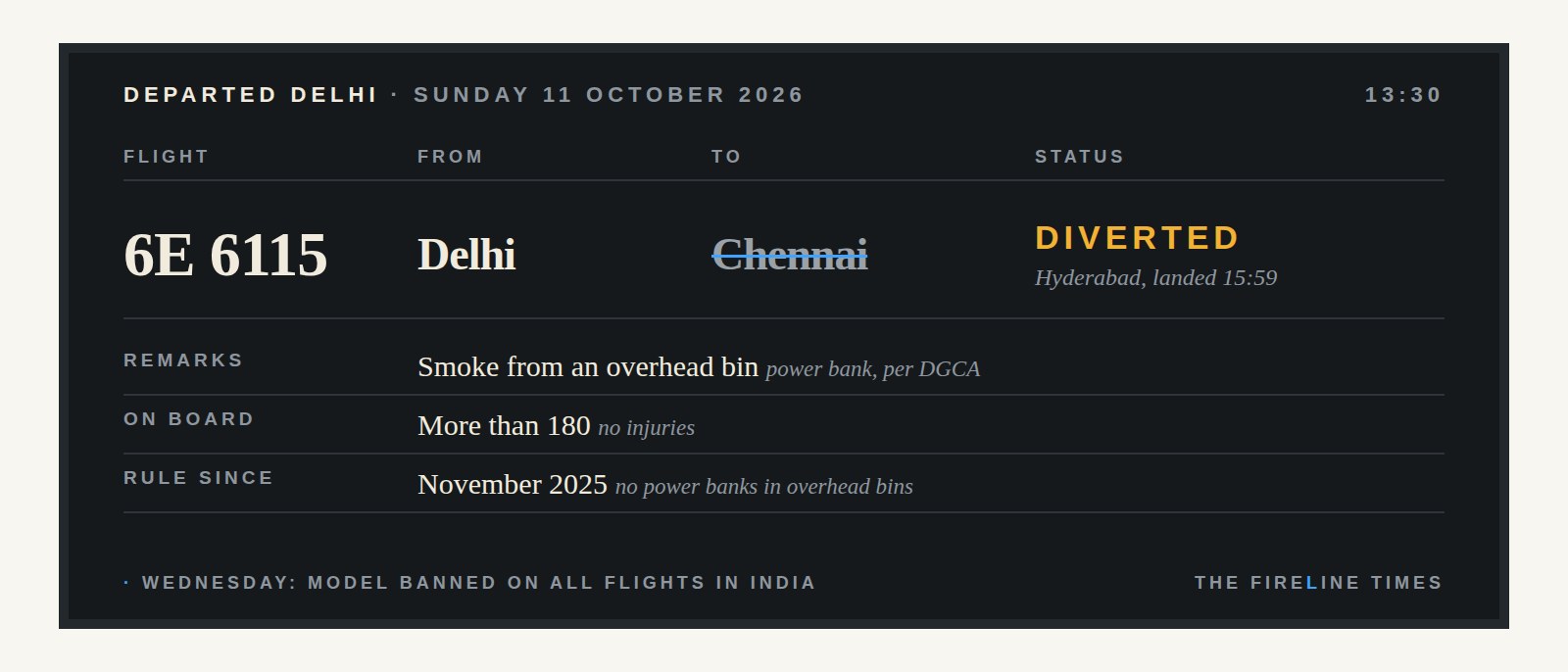
IndiGo flight 6E 6115 left Delhi for Chennai at about half past one on Sunday afternoon, an Airbus A321 with more than a hundred and eighty people on board. Some time into the flight, smoke began to come out of an overhead luggage compartment.
The video one passenger took is the version most people have now seen. Someone shouts fire. Someone else tells everyone to stay calm. People stand and pull at bags, and then start beating at the compartment with them, and with whatever cloth is to hand, until the cabin crew arrive with extinguishers and bring it under control. The pilots turned for Hyderabad and landed at Rajiv Gandhi International a minute before four. Nobody was injured. IndiGo put its passengers on another aircraft to Chennai.
The airline's own statement says only that smoke was detected from a customer's personal electronic device. Indian reporting says it was a power bank, and on Wednesday the Directorate General of Civil Aviation said so too, in the most direct way available to it. It banned one model, the MOBIKINS MK-PB-04, from every passenger and cargo flight to, from or within India, and told passengers to check the model number of whatever they are carrying. It is not a ban on power banks. The cause of this fire has not been published.
THE RULE ALREADY EXISTED
What makes the flight worth writing about is not that a battery failed. Batteries fail. It is where this one was.
India's regulator issued a dangerous goods circular last November. Power banks and spare lithium batteries go in hand baggage only, and they are not to be stored in overhead compartments. In January it went further and banned charging anything from a power bank during a flight, seat sockets included. Airlines must tell passengers both.
This was IndiGo's third device fire in a year. Last October a power bank caught fire on a Delhi to Dimapur flight while it taxied, and the crew put it out. In May more than two hundred passengers were evacuated at Chandigarh after another one caught fire on the ground, and several were hurt getting off the aircraft.
The rule about overhead bins did not come from India. It came from Busan. In January last year an Air Busan A321 waiting to leave for Hong Kong caught fire in a rear overhead compartment. All a hundred and seventy six people got out. The aircraft did not; it was a total loss. Korean investigators put it down to insulation breaking down inside a power bank in the bin, and by March Korea had banned power banks from overhead bins on its airlines. Airlines elsewhere tightened their own rules.
WHY THE BIN
An overhead bin is the one place in a cabin where a fire can start with nobody watching. It is closed. It is packed with clothes and bags, which burn. It is above head height, so the first anyone knows is smoke coming out of the seam, and the first thing anyone has to do is open it. A power bank in your pocket or under the seat in front gets hot in your hand, or smells, and someone notices while it is still a battery. In a bin it is already a fire by the time anyone sees it.
That is why the rule is about minutes. It is not saying the bin causes fires. It is saying the bin hides them.
WHAT THE GUIDANCE ACTUALLY SAYS
There is a second thing on Sunday's video that is worth noticing, and it is the bit that went right. The crew arrived with extinguishers and brought the fire under control. Good. But a lithium fire is not finished when the flame goes out, and the people who write cabin procedures know it.
Singapore's Civil Aviation Authority sets the drill out plainly in its advisory on lithium batteries in the cabin. Use halon or a halon replacement on the flame first, because that is what it is for. Then douse the device with water or another non-flammable liquid, because halon on its own is not effective against a lithium battery, and without cooling, the heat moves into the next cell and the pack can reignite, more than once. Do not pick it up. Do not cover it in ice, which only insulates it. Keep watching it, and keep cooling it.
Readers of this paper will recognise that. It is the same distinction we drew last week about India's grid batteries. The flame and the cell next to it are two different problems. A crew that has been trained for both deals with both. Banning one model deals with neither, and was never meant to. That is what the training is for.
HOW OFTEN
Nobody publishes a world figure. The United States does publish its own. The Federal Aviation Administration counted ninety three lithium battery incidents on aircraft in 2025, smoke, fire or extreme heat, eighty of them on passenger flights. Battery packs were the largest single group, then vapes, then phones. That is nearly two a week, in one country's airspace, and the FAA says its list is not complete.
WHAT TO DO WITH YOURS
None of this needs a product. Keep the power bank on you, or in the bag under the seat in front, not in the bin. Do not charge from it in the air; in India that is now the law. If anything in your bag gets hot, swells or smells, tell the crew straight away and do not try to move it. And if you fly in India, look at the model number on the back.
The rule about the overhead bin is not really about the bin. It is about the minutes between the first wisp of smoke and the first person who can reach it. On Sunday there were enough of them, and a hundred and eighty people got to Chennai a few hours late.
SOURCES
IndiGo statement, 11 October 2026, as reported by International Business Times UK and AeroXplorer · Directorate General of Civil Aviation order on the MOBIKINS MK-PB-04, as reported by Business Standard and Telangana Today, 14 October 2026 · DGCA Dangerous Goods Advisory Circular, November 2025, and in-flight charging ban, January 2026 · Aviation and Railway Accident Investigation Board, Korea, Air Busan 391 preliminary findings, 2025 · Civil Aviation Authority of Singapore, Advisory Circular AC 121-2-7, Management of Lithium Batteries in the Aircraft Passenger Cabin · US Federal Aviation Administration lithium battery incident data for 2025, as reported by Lion Technology.