The Fire LabTHE FIRE LAB  ·  OFFENSIVE DEFENCE
FIRE INTELLIGENCE
WWW.THEFIRELAB.IRG.AE
The FireLine Times
MIDDLE EAST•EUROPE•AFRICA•ASIA-PACIFIC
LATEST DISPATCH
THURSDAY, 15 OCTOBER 2026
PUBLISHED BY THE FIRE LAB
DISPATCH — HYDERABAD 15 OCTOBER 2026

It caught fire in the one place the rules say it must not go.

A power bank in an overhead bin filled an IndiGo cabin with smoke on Sunday, and passengers fought it with their bags until the crew reached it. Nobody was hurt. By Wednesday the regulator had banned the model on every flight in India. The rule it broke has been in place since last November, and it is a rule about minutes, not about luggage.
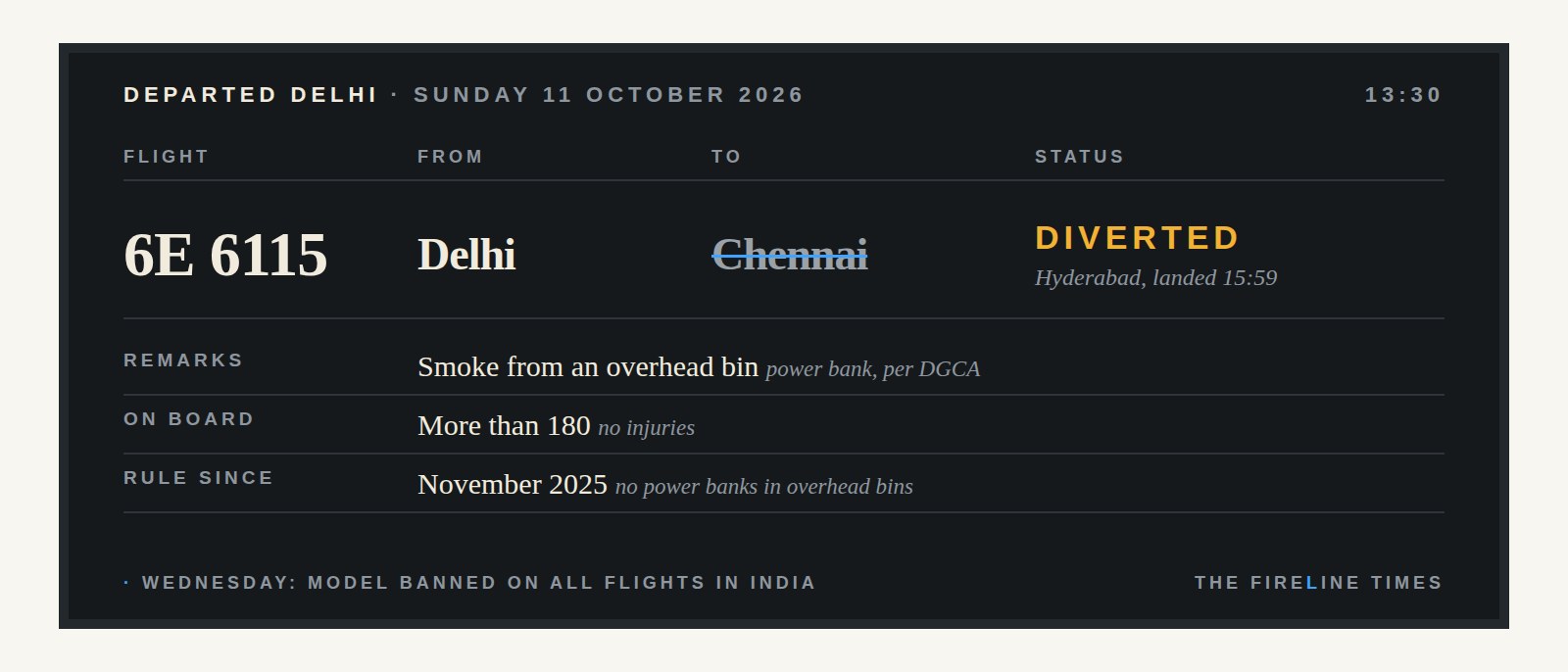
Flight information board: flight 6E 6115, Delhi to Chennai, diverted to Hyderabad, landed 15:59. Remarks: smoke from an overhead bin.
Sunday afternoon. The flight, the route and the diversion, as the boards would have shown it. Times from flight-tracking data. Graphic: The Fire Lab

IndiGo flight 6E 6115 left Delhi for Chennai at about half past one on Sunday afternoon, an Airbus A321 with more than a hundred and eighty people on board. Some time into the flight, smoke began to come out of an overhead luggage compartment.

The video one passenger took is the version most people have now seen. Someone shouts fire. Someone else tells everyone to stay calm. People stand and pull at bags, and then start beating at the compartment with them, and with whatever cloth is to hand, until the cabin crew arrive with extinguishers and bring it under control. The pilots turned for Hyderabad and landed at Rajiv Gandhi International a minute before four. Nobody was injured. IndiGo put its passengers on another aircraft to Chennai.

The airline's own statement says only that smoke was detected from a customer's personal electronic device. Indian reporting says it was a power bank, and on Wednesday the Directorate General of Civil Aviation said so too, in the most direct way available to it. It banned one model, the MOBIKINS MK-PB-04, from every passenger and cargo flight to, from or within India, and told passengers to check the model number of whatever they are carrying. It is not a ban on power banks. The cause of this fire has not been published.

THE RULE ALREADY EXISTED

What makes the flight worth writing about is not that a battery failed. Batteries fail. It is where this one was.

India's regulator issued a dangerous goods circular last November. Power banks and spare lithium batteries go in hand baggage only, and they are not to be stored in overhead compartments. In January it went further and banned charging anything from a power bank during a flight, seat sockets included. Airlines must tell passengers both.

This was IndiGo's third device fire in a year. Last October a power bank caught fire on a Delhi to Dimapur flight while it taxied, and the crew put it out. In May more than two hundred passengers were evacuated at Chandigarh after another one caught fire on the ground, and several were hurt getting off the aircraft.

The rule about overhead bins did not come from India. It came from Busan. In January last year an Air Busan A321 waiting to leave for Hong Kong caught fire in a rear overhead compartment. All a hundred and seventy six people got out. The aircraft did not; it was a total loss. Korean investigators put it down to insulation breaking down inside a power bank in the bin, and by March Korea had banned power banks from overhead bins on its airlines. Airlines elsewhere tightened their own rules.

WHY THE BIN

An overhead bin is the one place in a cabin where a fire can start with nobody watching. It is closed. It is packed with clothes and bags, which burn. It is above head height, so the first anyone knows is smoke coming out of the seam, and the first thing anyone has to do is open it. A power bank in your pocket or under the seat in front gets hot in your hand, or smells, and someone notices while it is still a battery. In a bin it is already a fire by the time anyone sees it.

The flame and the cell next to it are two different problems.

That is why the rule is about minutes. It is not saying the bin causes fires. It is saying the bin hides them.

WHAT THE GUIDANCE ACTUALLY SAYS

There is a second thing on Sunday's video that is worth noticing, and it is the bit that went right. The crew arrived with extinguishers and brought the fire under control. Good. But a lithium fire is not finished when the flame goes out, and the people who write cabin procedures know it.

Singapore's Civil Aviation Authority sets the drill out plainly in its advisory on lithium batteries in the cabin. Use halon or a halon replacement on the flame first, because that is what it is for. Then douse the device with water or another non-flammable liquid, because halon on its own is not effective against a lithium battery, and without cooling, the heat moves into the next cell and the pack can reignite, more than once. Do not pick it up. Do not cover it in ice, which only insulates it. Keep watching it, and keep cooling it.

Readers of this paper will recognise that. It is the same distinction we drew last week about India's grid batteries. The flame and the cell next to it are two different problems. A crew that has been trained for both deals with both. Banning one model deals with neither, and was never meant to. That is what the training is for.

HOW OFTEN

Nobody publishes a world figure. The United States does publish its own. The Federal Aviation Administration counted ninety three lithium battery incidents on aircraft in 2025, smoke, fire or extreme heat, eighty of them on passenger flights. Battery packs were the largest single group, then vapes, then phones. That is nearly two a week, in one country's airspace, and the FAA says its list is not complete.

WHAT TO DO WITH YOURS

None of this needs a product. Keep the power bank on you, or in the bag under the seat in front, not in the bin. Do not charge from it in the air; in India that is now the law. If anything in your bag gets hot, swells or smells, tell the crew straight away and do not try to move it. And if you fly in India, look at the model number on the back.

The rule about the overhead bin is not really about the bin. It is about the minutes between the first wisp of smoke and the first person who can reach it. On Sunday there were enough of them, and a hundred and eighty people got to Chennai a few hours late.

SOURCES

IndiGo statement, 11 October 2026, as reported by International Business Times UK and AeroXplorer · Directorate General of Civil Aviation order on the MOBIKINS MK-PB-04, as reported by Business Standard and Telangana Today, 14 October 2026 · DGCA Dangerous Goods Advisory Circular, November 2025, and in-flight charging ban, January 2026 · Aviation and Railway Accident Investigation Board, Korea, Air Busan 391 preliminary findings, 2025 · Civil Aviation Authority of Singapore, Advisory Circular AC 121-2-7, Management of Lithium Batteries in the Aircraft Passenger Cabin · US Federal Aviation Administration lithium battery incident data for 2025, as reported by Lion Technology.
THE FIRELINE TIMES BY EMAIL

New dispatches, as they are published.

Fire, regulation and the people who deal with both, from Dubai, South Africa, Europe and India. No sales emails. To stop, reply and say so.

We use your address only to send The FireLine Times. It goes to ignite@irg.ae and nowhere else.

THE PRODUCTS
ATOM and TITAN are the two formats of GASVAC™, our microencapsulated suppression technology. Open any product for the technical detail.
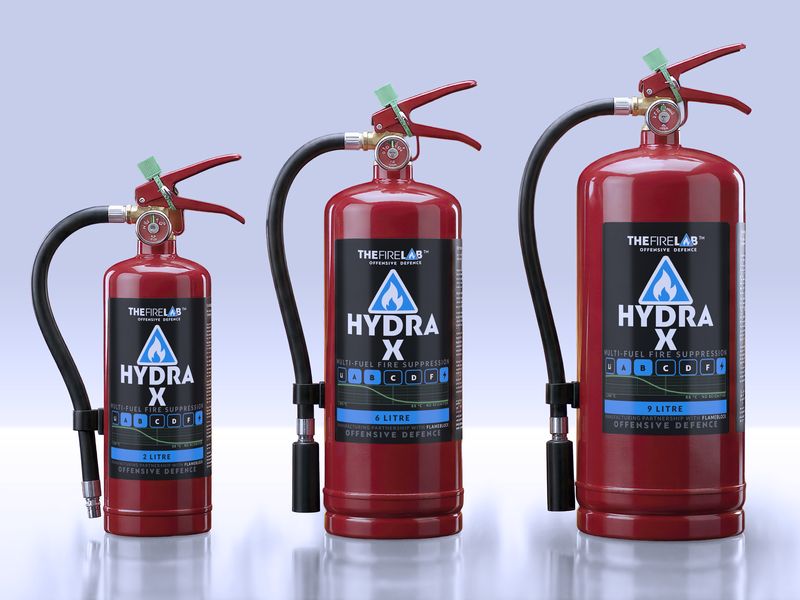
Hydra X in three red extinguishers, small to large.

Hydra X

HYDROCARBON, FUEL AND DEEP-SEATED FIRES

A 6% concentrate that changes what a water supply can do — penetration, faster heat removal, and a fire that stays out.

TECHNICAL DETAILCLOSE

Hydra X goes into a standard foam induction system at six per cent and changes the behaviour of the water already on site. It reduces the surface tension of that water so it wicks into porous material instead of beading and running off it, and it removes heat faster, so the fuel drops below the temperature it needs to re-ignite rather than the flame simply being knocked down while the fuel stays hot underneath.

It is intended for lithium-ion and electric vehicle battery fires, hydrocarbon and oil fires, tyre and rubber fires, and industrial suppression systems in mining, logistics and energy. It is fully water soluble and works with foam equipment you already own, so adopting it is a change of concentrate rather than a change of kit.

The formulation is PFAS free. For anyone replacing a fluorinated foam under current or anticipated restrictions, that is usually the first question and it is worth asking us for the composition in writing.

TECHNICAL
Induction rate 6%  ·  Appearance clear light amber liquid  ·  Solubility fully water soluble  ·  Freezing point approx. −13°C concentrate, −3°C diluted  ·  Formulation PFAS free  ·  Storage sealed HDPE-compatible containers

Handling. Hydra X is a concentrate and is handled like one. It carries an eye irritation classification, so gloves and eye protection when decanting or proportioning. The full safety data sheet, composition included, goes out with every enquiry.

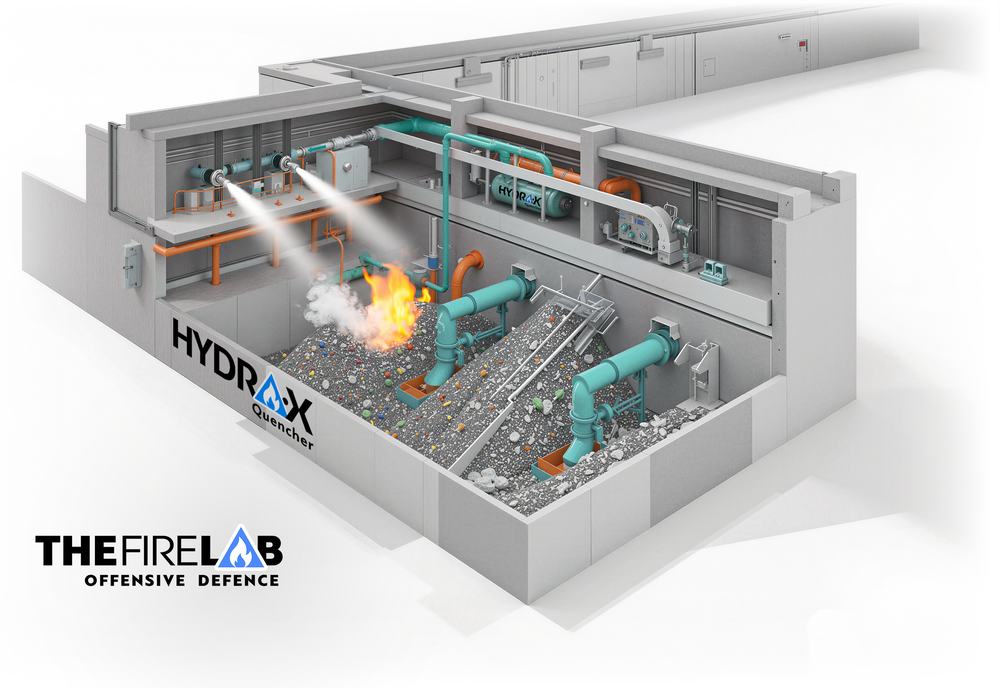
Technical cutaway of a waste bunker fitted with a fixed Hydra X system. Two ceiling-mounted monitors discharge onto a fire in the tipping pit, fed by distribution pipework from the plant deck above.
A fixed installation over a waste bunker. Ceiling-mounted monitors discharge onto the fire in the tipping pit, fed at six per cent from the plant deck above. The same concentrate runs through fixed systems, appliances and hand lines.
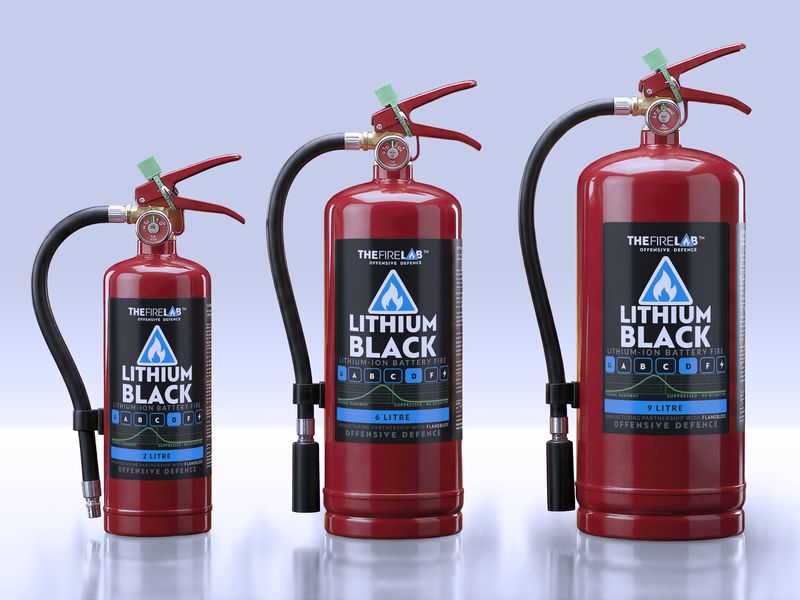
Lithium Black in three red extinguishers, small to large.

Lithium Black

LITHIUM BATTERY FIRES

Suppresses the flame, cuts the toxic off-gassing, then cools cells individually so heat cannot transfer to the neighbouring cell.

TECHNICAL DETAILCLOSE

A lithium-ion battery fire sustains itself. It generates its own heat, liberates its own oxygen from the metal oxides in the cell, and carries its own combustible electrolyte. Cooling the outside of the pack does not reach any of that.

Lithium Black is a mineral-based agent, not a polymer gel. Natural minerals and dissolved organic and inorganic salts bond ionically to form a three-dimensional structure that is gel-like at rest and thins under pressure, so it pumps and sprays but stays where it lands. It works on three fronts at once: it absorbs heat rapidly and keeps cooling, it lays down a layered mineral coating that excludes oxygen, and it introduces natural antioxidant compounds that quench the free radicals driving the combustion cycle.

The residual coating is doing work after the fire is out. It should not be washed off.

TECHNICAL
Appearance black viscous liquid  ·  Rheology gel at rest, shear-thinning under pressure  ·  Polymer content none  ·  Shelf life minimum 36 months  ·  Storage below 30°C  ·  Standard packaging 6 litre pressurised extinguisher
INDEPENDENT TESTING Suppression testing at Ignis Lab, Cape Town, September 2024. Third-party review by Professor Richard Walls, Stellenbosch University, September 2024. Extinguisher testing to NTA 8133 by M-Lab in the Netherlands, February 2026, on a nine-litre unit. Reports available on request.
A row of containerised battery energy storage units with solar arrays mounted above them, on the edge of a city.
Containerised storage with solar. The risk arrives with the cells, not the weather.
WHERE IT IS USED
Battery energy storage installations  ·  electric vehicles and charging infrastructure  ·  data centres and UPS rooms  ·  battery manufacturing and storage  ·  waste and recycling, where damaged cells arrive hidden in the stream
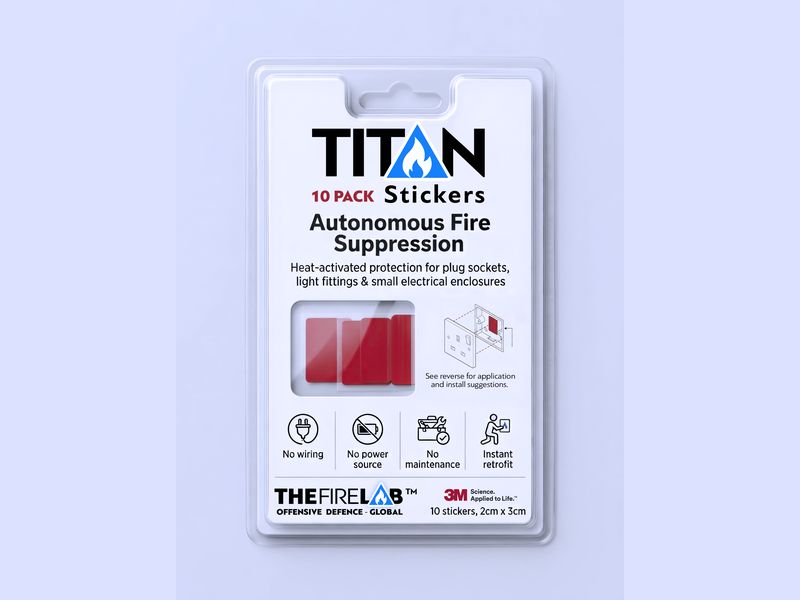
A TITAN ten-pack of autonomous fire suppressant stickers in its blister pack.

TITAN

CABINETS, PANELS AND ENCLOSURES

A pad fixed inside the enclosure. No power, no wiring, no detection. Discharges clean agent at the seat of the fire.

TECHNICAL DETAILCLOSE

Most electrical fires start inside something — a distribution board, a switch box, a control panel, a server cabinet. By the time a detector in the ceiling has noticed, the fire has had the run of the enclosure and everything in it.

TITAN is a self-adhesive pad fixed inside that enclosure, next to the thing likely to fail. It has no power supply, no wiring, no sensor and no service interval. The polymer microcapsules in it rupture at around 120°C and release the agent at the seat of the fire, inside the box, before anything outside has reacted.

It is dielectric and non-conductive, so it can be fitted alongside live equipment, and it works in humid or smoke-filled conditions and during a power cut, because it does not depend on anything electrical. Suppression happens capsule by capsule, so a pad is not spent by a single event.

TECHNICAL
Activation approximately 120°C  ·  Electrical dielectric, non-conductive, safe near live equipment  ·  Services required none — no power, sensors, wiring or maintenance  ·  Formats self-adhesive pads in several sizes
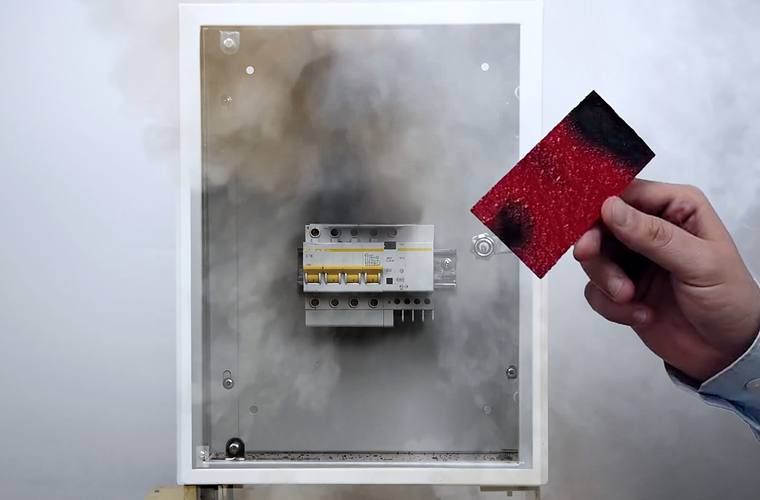
A distribution board filled with smoke after a fire inside it, with a scorched TITAN pad held up beside the open enclosure.
After the event. The pad has discharged inside the enclosure and the board is still standing.
TYPICAL LOCATIONS
Distribution boards and consumer units  ·  switch boxes and control panels  ·  server and comms cabinets  ·  UPS enclosures  ·  cable trenches  ·  battery packs and charging cabinets
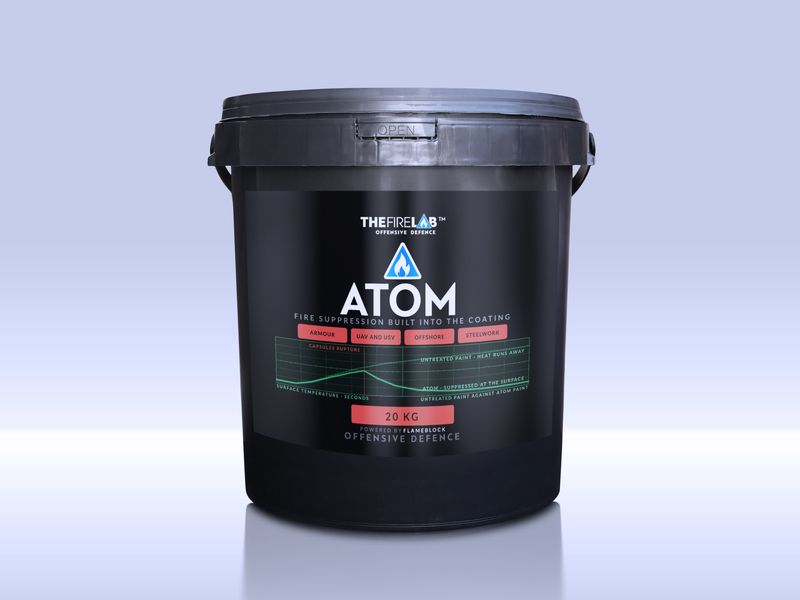
A pail of ATOM.

ATOM

COATINGS FOR VEHICLES AND PLANT

Microencapsulated agent mixed into the coating, activating at the point of heat and drawing heat out as it extinguishes.

TECHNICAL DETAILCLOSE

ATOM is the same suppression technology as TITAN, supplied loose. The microcapsules come in bulk or as an additive to be mixed into paints and coatings, so the protection goes onto a surface rather than into a box.

That matters where there is no enclosure to protect — the underside of a vehicle, a run of plant, a steel structure, a cable trench, a server room floor. The coating does an ordinary job in ordinary conditions: it is hard, wear resistant, weather and UV resistant, and it protects the substrate from corrosion. It only becomes a fire suppression system at the moment the surface gets hot enough.

It goes on by spray, brush or roller in two or three coats, cures at room temperature and is surface dry within about two hours.

TECHNICAL
Trigger temperature 110°C ±10  ·  Film thickness 50–200 μm  ·  Operating range −40°C to 70°C  ·  Drying surface dry ≤2h, full dry ≤24h, full cure 7 days  ·  Durability salt spray 1,000 hours, water resistance 240 hours, hardness ≥2H  ·  Substrates steel, aluminium, concrete, wood, plastic, glass, ceramics  ·  Shelf life 2 years
WHERE IT IS USED
Vehicles and rail cars  ·  industrial equipment and precision machinery  ·  server rooms and data centres  ·  chemical tanks, reactors and pipelines  ·  steel structures and heritage buildings  ·  archives, libraries and vaults
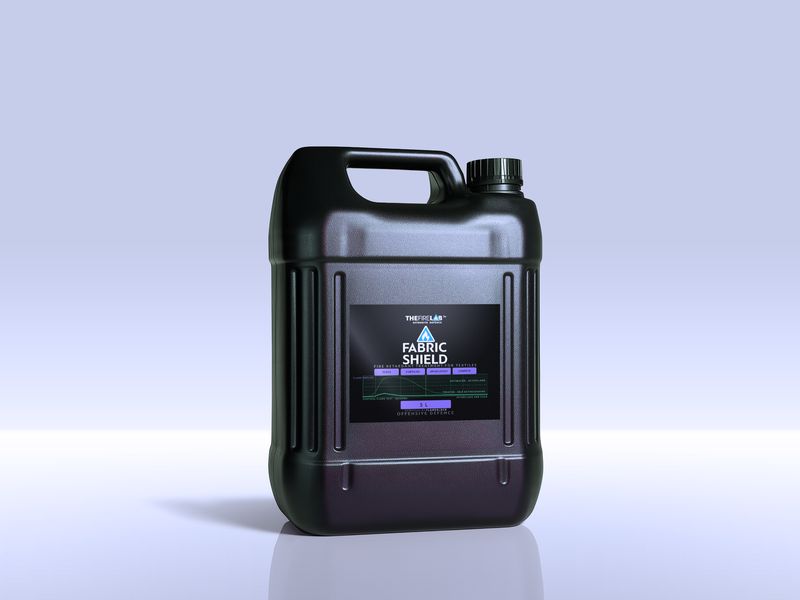
Fabric Shield in a jerry can.

Fabric Shield

TEXTILES AND SOFT FURNISHINGS

Treated material carbonises rather than sustaining flame — stopping spread and buying evacuation time.

TECHNICAL DETAILCLOSE

In a room fire, soft furnishings are usually what turns a contained incident into a room fully involved. Curtains and upholstery carry flame up and across faster than anything else in the space.

Fabric Shield is a clear, water-based retardant sprayed onto the textile. It dries to an invisible barrier and does not change the colour, texture, drape or feel of the material, which is the practical objection most people have to treating a fabric at all. Treated material carbonises rather than sustaining flame, so the fire stops travelling and the people in the room get their evacuation time back.

It is odourless once dry and safe for indoor use, and protection lasts up to three years in normal conditions before retreatment.

TECHNICAL
Appearance clear liquid, viscosity similar to water  ·  pH 6.5–7.5, neutral  ·  Density approx. 1.0 g/cm³  ·  Flash point none, non-flammable  ·  Durability up to 3 years under normal conditions
TYPICAL APPLICATIONS
Curtains, drapes and upholstery  ·  carpets and wall fabrics  ·  tents, marquees and exhibition fabrics  ·  stage and theatre curtains  ·  decorative textiles in hotels, schools and public buildings
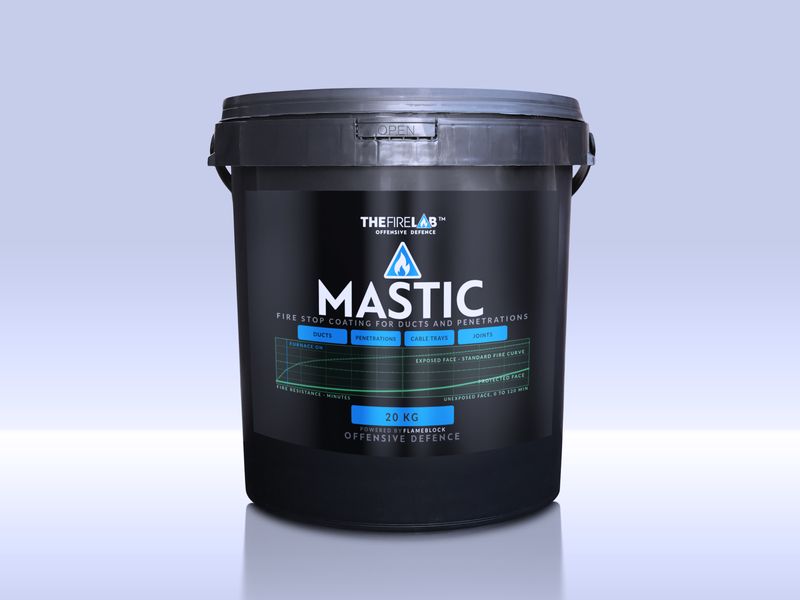
A pail of Mastic.

Mastic

CABLE PENETRATIONS AND SERVICE OPENINGS

Seals the openings through which fire and smoke actually travel between compartments, keeping fire-rated walls and floors intact.

TECHNICAL DETAILCLOSE

A fire-rated wall is only rated until somebody drills through it. Cables, conduits and services are added and moved throughout a building's life, and every hole is a route for fire and smoke into the next compartment. The compartmentation on the drawings and the compartmentation in the building are rarely the same thing.

Mastic is a water-based fire stop coating for sealing those openings — around cable and conduit penetrations, through-wall and floor openings, and construction joints. It goes on by brush, roller or spray, adheres to most common building substrates, and cleans up with water before it cures. It is low VOC and suitable for use indoors.

It is maintenance work rather than a product installation, and it is the cheapest fire safety intervention in most buildings.

TECHNICAL
Appearance white coating  ·  pH approx. 7  ·  Density 1.29–1.32 g/cm³  ·  VOC low, compliant with indoor air quality requirements  ·  Packaging 20 kg sealed containers  ·  Shelf life 12 months unopened at 5–35°C
TYPICAL APPLICATIONS
Fire-stopping around cables, conduits and service penetrations  ·  sealing through-wall and floor openings  ·  fire barriers in walls, ceilings and floors  ·  maintaining fire-resistive construction details
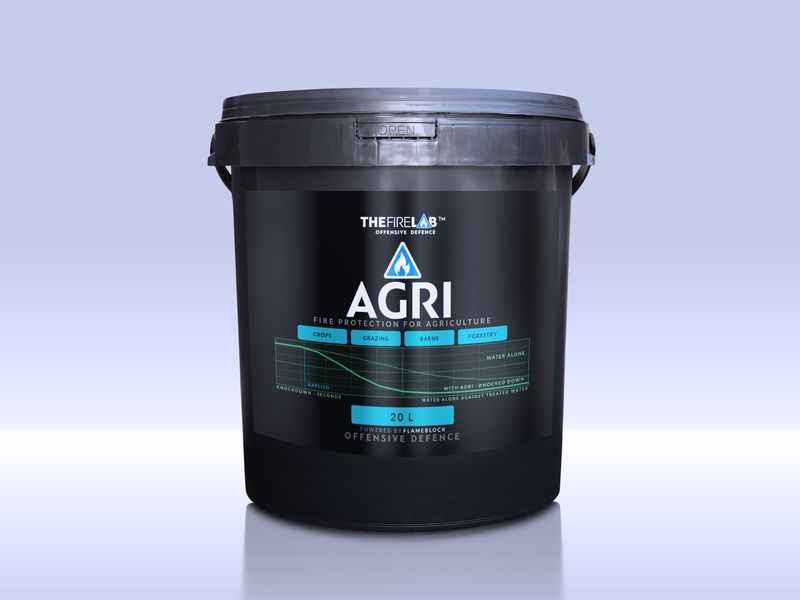
A pail of AGRI.

AGRI

CROPS, GRAZING AND FARM STRUCTURES

Holds water in vegetation and soil so a treated strip stays wet after the tanker has moved on.

TECHNICAL DETAILCLOSE

A farm fire has everything in its favour. The fuel is dry, it is continuous, and it is spread over a distance no fire service can cover quickly. By the time an appliance arrives the fire has usually decided the outcome.

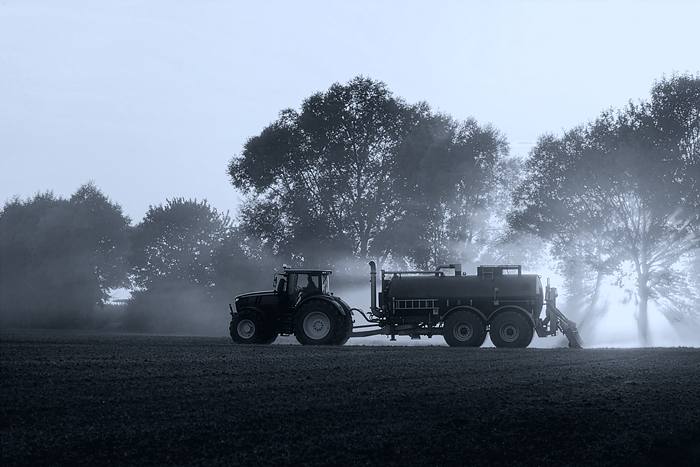
AGRI changes what a water bowser can do. It lowers the surface tension of the water so it penetrates scrub and grass instead of sitting on top of them, and it holds moisture in the vegetation and the soil for longer, so a strip stays protected after the tractor has moved on. That turns a tanker into something that can lay a line rather than chase a front.

It is used on crop fields and forestry edges, around barns, silos and stores, and across grazing land — the places where a farm's year is kept.

TECHNICAL
Action reduces surface tension for penetration into scrub and grass  ·  Retention improves water absorption and retention in vegetation and soil  ·  Application through standard farm bowsers, booms and knapsacks
A tractor drawing a tanker across a field at dusk, spray drifting behind it.
Laid from a standard bowser. The equipment is already on the farm.
WHERE IT IS USED
Crop fields and stubble  ·  forestry edges and firebreak lines  ·  barns, silos and machinery stores  ·  grazing land and livestock zones  ·  hay and silage stacks  ·  golf courses and high-value landscaped grounds
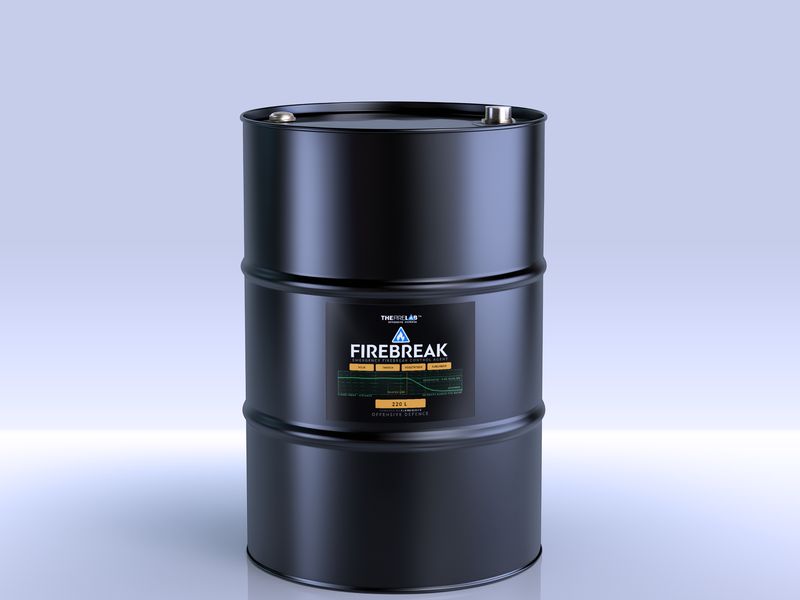
A drum of FIREBREAK.

Fire Break

VELD, PLANTATION AND STUBBLE

Treats a strip of ground so the fire arrives at it and stops, without cutting or burning a break first.

TECHNICAL DETAILCLOSE

Fire seasons are getting longer at both ends, and every El Niño turns that dial further. Forecasters predict the next one will be severe, and it will find ground drier than the last.

A firebreak works by taking the fuel away — ploughing it, cutting it, or burning it deliberately before the season. All three cost land, time and a window of dry weather, and a burnt break is itself a fire you have to control.

Fire Break treats the fuel instead of removing it. Applied to a strip ahead of an advancing fire, or laid in advance across the lines you want to hold, it leaves the vegetation standing and unwilling to burn. The fire reaches the treated ground and runs out of anything to do.

It is intended for veld fires in savannah grassland and Mediterranean scrub, for large-scale arable where a fire in standing maize moves faster than machinery, for commercial plantations in the paper and pulp industry, and around timber and wood product yards. Across Africa and Australia, millions of hectares of farmland go every year.

TECHNICAL
Use applied ahead of a fire, or on chosen lines before the season  ·  Environmental biodegradable  ·  Transport no regulations apply; not classified as hazardous  ·  Packaging 5 and 20 litre buckets  ·  Storage dry and cool, below 30°C, out of direct sunlight
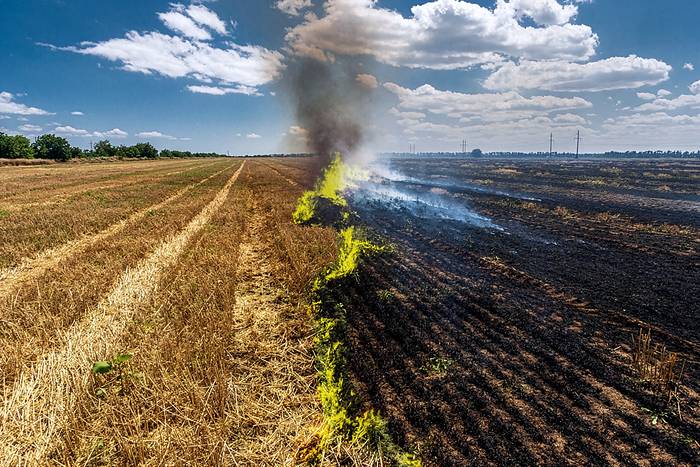
A stubble fire burning along a line across a field, with blackened ground on one side and untouched stubble on the other.
The whole job, in one picture. Everything depends on where the fire is asked to stop.
WHERE IT IS USED
Savannah grassland and Mediterranean scrub  ·  large-scale arable, maize and cereals  ·  commercial plantations, paper and pulp  ·  timber yards and wood product manufacturing
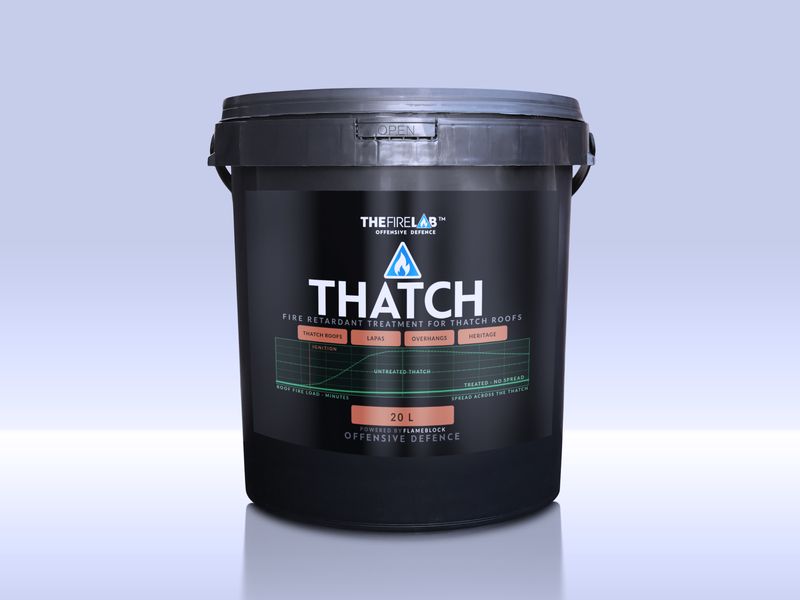
A pail of THATCH.

THATCH

THATCHED ROOFS

A surveyed and sprayed treatment for the one roof covering that is made entirely of dry grass.

TECHNICAL DETAILCLOSE

A thatched roof is a substantial volume of dry grass sitting directly over the space people live in. It is also, usually, the most valuable thing about the building. Insurers know both facts, which is why thatch is priced the way it is.

THATCH is not a tin you buy and apply yourself. It is a survey followed by an application, done by trained contractors, and the survey matters as much as the spray. The roof is checked first — that the thatch is at least 175 millimetres thick, that rafters are no more than 900 millimetres apart and laths no more than 250, that the layer is properly compacted and the binding is tensioned, and that the structure is sound. A treatment laid over a roof in poor condition is money spent twice.

Application is by airless sprayer, outside first, in dry weather, finishing in good time before the temperature drops so the treatment cures properly. Quantity is calculated from roof area rather than guessed.

TECHNICAL
Delivered by trained contractors, not sold for self-application  ·  Minimum thatch thickness 175 mm  ·  Rafter spacing not more than 900 mm  ·  Lath spacing not more than 250 mm  ·  Coverage approximately 1.2 litres per m² of roof, 1.4 on an older roof  ·  Application airless spray, dry weather only
WHERE IT IS USED
Thatched houses and cottages  ·  lodges, lapas and boma roofs  ·  hotels and game reserves  ·  restaurants and event venues  ·  heritage and listed buildings
WHY IT IS A SERVICE
The survey decides whether the treatment will work at all. Thickness, compaction, spacing and the condition of the structure all change the answer, and none of them can be judged from the ground.
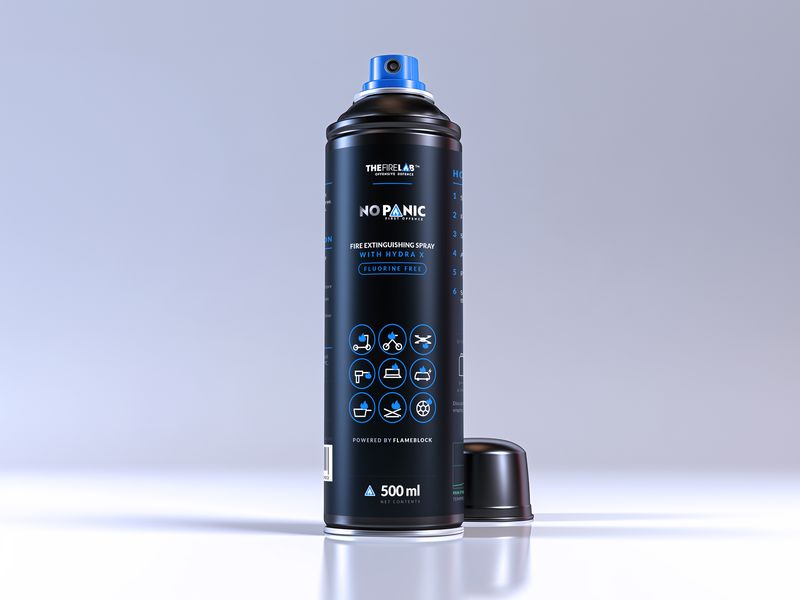
A NOPANIC aerosol can with its cap beside it.

NOPANIC

KITCHEN, BATTERY AND EVERYDAY FIRES

One compact can for the fires that are hard to deal with: lithium-ion batteries, pan and oil fires, and the everyday fire at home or at work.

TECHNICAL DETAILCLOSE

A pan fire is the most common fire there is, and a lithium-ion battery fire is the one people are least ready for. Most of the small extinguishers kept at home or at work were not made for either.

NOPANIC is a molecular-engineered fire extinguishing spray in a compact aluminium aerosol, formulated with Hydra X. It covers Class A fires in wood, textiles, paper, rubber and other carbon-based materials, Class B fires in oil, diesel, paraffin and hydraulic fluid, Class F fires in pans, cooking oil and fat, and lithium-ion battery fires in phones, laptops, power banks, power tools, e-bikes and scooters.

It is small enough for a kitchen drawer, a van door pocket or a workshop shelf, which is the point. It is kept close to where fires start, so it is there in the first seconds. NOPANIC replaces our earlier pan-fire sachet.

TECHNICAL
Format compact aluminium aerosol  ·  Agent formulated with Hydra X  ·  Fire classes A, B and F, and lithium-ion battery fires  ·  Use single use, discard the can afterwards

Always read the label. Not for use on live electrical equipment, metal fires or petrol fires. It is a pressurised container, so keep it out of direct sunlight and away from heat. Ask us for the product documentation at ignite@irg.ae.

WHERE IT IS USED
Home kitchens  ·  restaurants, hotels, catering and food trucks  ·  workshops and garages  ·  cars, vans, caravans and boats  ·  charging points for e-bikes, scooters and power tools
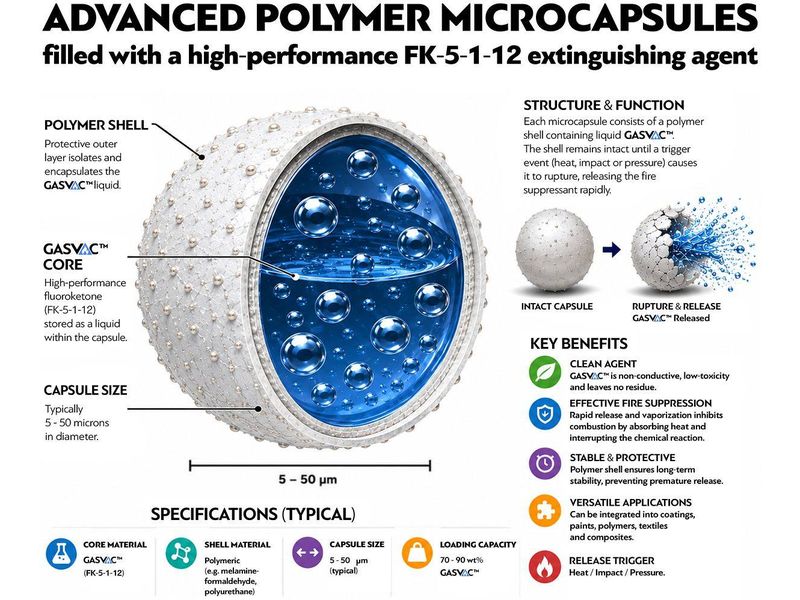
Diagram of a GASVAC microcapsule, cut away to show the polymer shell and the liquid agent inside.

GASVAC™

THE TECHNOLOGY BEHIND ATOM AND TITAN

Polymer microcapsules that rupture at the point of thermal failure and release clean agent exactly where the heat is.

TECHNICAL DETAILCLOSE

Conventional suppression is a system: a detector notices, a controller decides, a valve opens, and an agent floods a volume. Every one of those steps is a thing that can be late, or wrong, or unpowered.

GASVAC removes the system. The agent is held inside polymer microcapsules dispersed through a coating or a pad. Below the trigger temperature the capsules are simply part of the material — a hard, wear and corrosion resistant film that also happens to be full of extinguishant. At the trigger temperature the shells rupture and release the agent precisely where the heat is, while the matrix around them forms a gel-like thermal barrier. Chemical suppression and physical isolation, in one material, with no decision to make and nothing to power.

The capsule shells are engineered to survive ordinary life. They are rated to a compressive strength of 10 MPa and resist pH from 1 to 13, so they tolerate impact, washing and industrial atmospheres without releasing. There are no halogenated hydrocarbons and no heavy metals, and the agent leaves no residue and causes no corrosion.

TECHNICAL
Trigger temperature 110°C ±10  ·  Response 3–5 seconds  ·  Capsule shell compressive strength ≥10 MPa, resistant to pH 1–13  ·  Capsule size 5–50 microns  ·  Loading 70–90 wt%  ·  Residue none, non-corrosive  ·  Electrical non-conductive
THE TWO FORMATS
TITAN — the capsules in a self-adhesive pad, for cabinets, panels and enclosures.  ·  ATOM — the capsules in bulk or as a paint additive, for surfaces, vehicles, plant and structures.
Technical diagram of a GASVAC microcapsule. A cutaway shows the polymer shell enclosing the liquid fluoroketone core, labelled with shell, core and capsule size. Alongside, an intact capsule and a ruptured one releasing the agent, and a panel of key properties.
The capsule, cut away, and what happens to it. Typically five to fifty microns across, and there are millions of them in a coated surface.
WHERE IT IS USED

Military and defence

Armoured platforms, drones, field operations

Oil, gas and fuel storage

Terminals, depots, filling stations

Battery energy storage

BESS installations and charging infrastructure

Power and renewables

Substations, switchyards, solar and wind

Waste and recycling

Where water alone means contaminated runoff

Wildfire, peat and land

Moorland, bog, stubble and stockpiles

TECHNICAL LIBRARY

Technical data sheets, safety data sheets and independent test reports are available for every product in the range, on request to specifiers, distributors and insurers.

Lithium Black has been tested to NTA 8133 by M-Lab in the Netherlands, independently reviewed by Professor Richard Walls at Stellenbosch University, and suppression tested at Ignis Lab in Cape Town. We will send you those reports in full rather than quote from them.

Ask us for the current certification position on any product in your market and we will give it to you in writing.

Request documents at ignite@irg.ae.

ABOUT THE FIRE LAB

The Fire Lab is a global fire safety innovation platform, headquartered in Dubai. We manufacture through our manufacturing partners and deliver worldwide through regional hubs and a network of distribution partners.

Conventional fire safety is reactive. It responds once ignition has already happened. We work at the molecular level, at the point of failure — which is what Offensive Defence means.

Our hubs are in Dubai, South Africa and Switzerland, with a presence in Singapore covering Asia-Pacific.

The FireLine Times is our own record of that work — dispatches written from the field, published by The Fire Lab.

Partner with the future of fire safety.

One commercial relationship covering lithium-ion, hydrocarbon, electrical and structural fire risk — with a range that grows without adding suppliers.

BECOME A DISTRIBUTOR
CONTACT

Technical enquiries

Tell us what you are protecting and what could realistically catch fire. Our technical team will tell you which product fits. If nothing in the range does, that is a brief for the lab.
ignite@irg.ae

Distribution

Tell us about your business, the markets you cover and the customers you serve.
ignite@irg.ae

Press and dispatches

Pete Bevils, Chief Executive Officer.
pete@irg.ae

Follow The Fire Lab on LinkedIn.
New dispatches are posted there first.

RESTRICTED

Distributor portal

A private area for appointed distributors and their technical staff, holding the current version of everything you need to specify, quote and sell.

WHAT IS BEHIND IT Current technical and safety data sheets, every product  ·  independent test reports in full  ·  certification position by market  ·  product photography and artwork  ·  price files and order forms  ·  the dispatch archive
DISTRIBUTOR ACCESS

Credentials are issued to distributors holding an agreement with The Fire Lab.

No credentials yet? REQUEST ACCESS
Not a distributor yet? BECOME A DISTRIBUTOR
TOP ↑